Overall
108.5
Above avg
Metro cost profile · 2024 BEA RPP
Cost-of-living indicators for Vallejo, CA, from Bureau of Economic Analysis Regional Price Parities, overall, goods, services, and rents vs the U.S. average of 100.
Vallejo ranks #18 of 387 U.S. metros by cost, and its overall price index has fallen 8.3 points since 2008.
The verdict
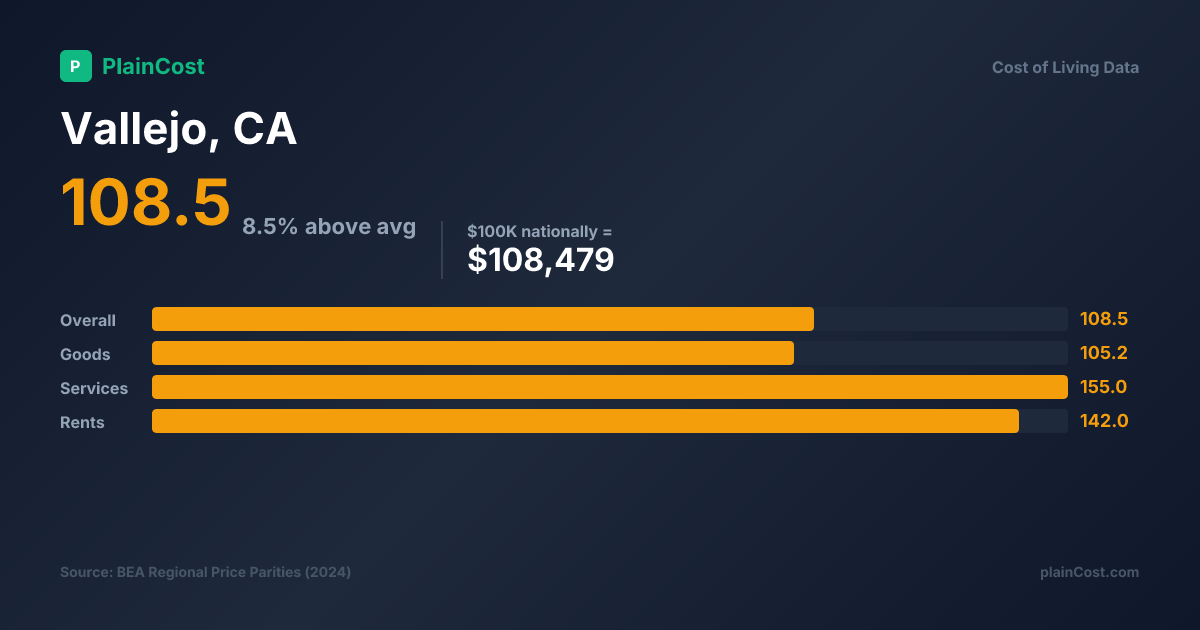
Vallejo is more expensive than 95% of U.S. metros, an overall cost index of 108.5, 8.5% above the national average, led by services at 155.0.
A $100,000 national salary carries the purchasing power of about $92,184 here; matching a $100K lifestyle takes roughly $108,479.
Vallejo vs every U.S. metro
Where this metro sits in the national cost distribution
109 Top 5% higher than 95% of 387 US metros
Each bar is a band; taller bars hold more US metros. The dashed line + filled bar mark this entry. Hover or tap any bar for its full count, share, and where it sits relative to this entry.
Source U.S. Bureau of Economic Analysis, Regional Price Parities · 2024
BEA RPP by category, 100 = national average
Rents
142 RPP
Services
155 RPP
Overall
108.5 RPP
Goods
105.2 RPP
What this shows Vallejo's strongest departure is services at 155.0; rents follows at 142.0. Labor-priced local activity, rather than housing alone, is the first budget line to investigate.
Metros near Vallejo's overall cost, plotted by their goods price (horizontal) and housing price (vertical). Same headline RPP, very different structures.
Overall
108.5
Above avg
Goods
105.2
Above avg
Services
155.0
Expensive
Rents
142.0
Expensive
Service-cost-led profile
Services are the defining pressure in Vallejo: the BEA services component is 155.0, farther above the national baseline than local rents or tradable goods. That service-heavy pattern explains an overall RPP of 108.5 differently from a housing-led metro.
Across all reported metros, the closest component-profile matches are Santa Rosa-Petaluma, CA, Salinas, CA, San Luis Obispo-Paso Robles, CA. They resemble Vallejo across goods, services, and rents together, so they are stronger structure peers than a place selected only because its overall RPP happens to be nearby.
Across 2008-2024, Vallejo's overall index has fallen by 8.3 points. This is a relative price-level history, not a prediction or a personal affordability recommendation; pair it with current local wages and housing options before making a decision.
A $100,000 salary at the national average cost of living equals:
in Vallejo, CA purchasing power
Use the salary calculator for custom amounts.
How far the median local paycheck goes here, combining income and housing cost
A weighted composite (60% purchasing power, 40% housing affordability) percentile-ranked against every other tracked metro; a missing input redistributes its weight rather than deflating the score. Sources: Census ACS 5-Year 2023 (income) + BEA Regional Price Parities 2024 (cost). Vintages differ by design; see methodology.
Latest BEA release change
Vallejo's overall RPP fell -0.9 points, from 109.4 in 2023 to 108.5 in 2024. The largest category movement was services, changing from 139.2 to 155.0. This is a relative change against the national benchmark, not a household's dollar bill.
The cost of living has been trending downward, decreasing by 8.3 points over this period. The largest single-year move was in 2018, when the index dropped 7.1 points from the year before.
Every year on record, national average = 100
| Year | Overall |
|---|---|
| 2008 | 116.8 |
| 2009 | 113.7 |
| 2010 | 111.9 |
| 2011 | 109.5 |
| 2012 | 109.7 |
| 2013 | 110.2 |
| 2014 | 110.7 |
| 2015 | 112.7 |
| 2016 | 113.1 |
| 2017 | 117.6 |
| 2018 | 110.5 |
| 2019 | 109.2 |
| 2020 | 110.7 |
| 2021 | 109.4 |
| 2022 | 112.6 |
| 2023 | 109.4 |
| 2024 | 108.5 |
Decision peers
These metros are closest to Vallejo's combined goods, services, and rents profile. They may not have the same overall RPP, but their price pressures are shaped in a similar way.
These metros have an overall RPP closest to Vallejo, CA's index of 108.5.
Showing the 6 closest of 387 metro areas tracked nationally.
CA-relative analysis
Among the 25 CA metros PlainCost tracks with reported goods prices data, Vallejo, CA ranks #4 - the 4th percentile within the state. This is a different, narrower cut than the nationwide rank above: it compares Vallejo, CA only against its own state's metros, not the full US field.
Ranked by raw value (highest first); a higher rank is not automatically "more expensive is worse", see the national comparison above for direction context. This is a comparison within CA only, not a livability score.
Two BEA RPP-derived peer sets for Vallejo, CA: nearest metros by overall regional price parity and by rents RPP. These are cross-state neighborhoods, not the in-state metro list below.
Nearest metros by overall regional price parity (108.5 here).
Nearest metros by rents regional price parity (142.0 here).
View all CA metros → Cheapest in CA → Most expensive in CA →
Cost of living guides →, cheapest and most-expensive metro rankings, salary negotiation with RPP data, and step-by-step comparison walkthroughs.
Shareable data card
Download the data card or share this exact metro record. The card uses the same BEA-derived values shown above.
What this means for Vallejo
How to read Vallejo's cost of living before a move, a job offer, or a budget.
RPP is BEA's annual price-level benchmark for the data year shown, not a live market quote. Pair it with current local wages and housing costs before deciding.
Vallejo, CA has a Regional Price Parity (RPP) index of 108.5, meaning it is 8.5% more expensive than the national average. Goods are indexed at 105.2, services at 155.0, and rents at 142.0. It ranks #18 out of 387 U.S. metro areas by overall cost.
To maintain the same purchasing power as a $100,000 salary at the national average, you would need approximately $108,479 in Vallejo, CA. Conversely, $100K earned in Vallejo, CA has the purchasing power of $92,184 at the national average.
Rents in Vallejo, CA are indexed at 142.0, which is 42.0% above the national average. This is significantly higher than typical U.S. rents.
From 2008 to 2024, Vallejo, CA's overall cost index changed by -8.3 points (from 116.8 to 108.5). The cost of living has been declining.
The priciest category in Vallejo, CA is services at 155.0, 55.0% above the national average. The most affordable category is goods at 105.2, 5.2% above average, still the lowest of the three categories.
Metros with the most similar overall cost index include San Luis Obispo-Paso Robles, Boston-Cambridge-Newton, Santa Maria-Santa Barbara. These areas have RPP values within a few points of Vallejo, CA's 108.5.

Every figure on PlainCost is rendered directly from BEA Regional Price Parity source data, no number is typed in by an editor. See our editorial standards & corrections policy, the methodology behind these numbers, our changelog, or report a data error. Data current as of 2026-08-11. Rankings measure the published cost-of-living index only; we don't recommend where to live or rate any metro's quality of life.