State cost profile · 2024 BEA RPP
Cost of Living in Massachusetts
Statewide Regional Price Parities for Massachusetts from the Bureau of Economic Analysis, overall, goods, services, and rents vs the U.S. average of 100, across 6 metro areas.
- 105.8
- Statewide RPP
- #7
- of 51 states by cost
- 128.1
- Rents RPP
- 6
- Metro areas
Massachusetts ranks #7 of 51 states by cost, and its statewide price index has held steady since 2008.
- stable since 2008
- fell -1.9 points in the 2023-2024 release
- similar cost to Maryland
The verdict
Massachusetts is more expensive than 86% of U.S. states, a statewide cost index of 105.8, 5.8% above the national average.
- Services
- furthest category from 100, at 152.1
- Maryland
- closest statewide cost peer, 0.8 points away
- Boston-Cambridge-Newton
- highest-cost metro, 108.3
- Pittsfield
- lowest-cost metro, 95.1
A $100,000 national salary carries the purchasing power of about $94,556 when earned in Massachusetts.
Reading the Massachusetts Cost of Living Picture
Massachusetts's nearest statewide cost peers are Maryland, Washington, New Hampshire. Those names define the relevant comparison lane: the question is which premium is driven by housing, services, or goods, not whether the state clears the national benchmark. Services and Goods are 53.3 points apart, so the statewide average joins two materially different household experiences.
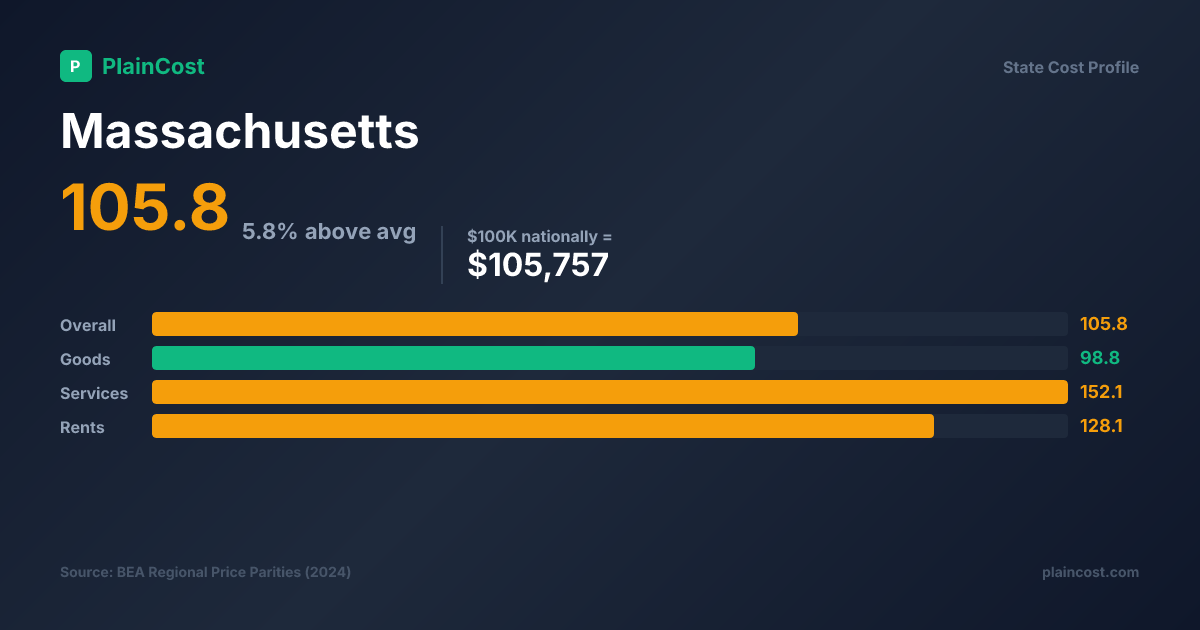
Massachusetts captures 6 metro areas in the BEA dataset, and the range across them is meaningful. Boston-Cambridge-Newton, MA-NH leads on cost at 108.3, while Pittsfield, MA sits at the opposite end at 95.1 - a gap of 13.2 index points inside a single state. For goods the state indexes at 98.8, for services 152.1, and for rents 128.1. Rents run 22.3 points above the statewide index here, so housing is carrying this state's cost position; the goods and services lines would place it noticeably cheaper on their own.
Over time, Massachusetts's statewide index has held steady within 0.3 points, suggesting a stable competitive position against other states. Practically, this means a $100,000 national salary delivers the purchasing power of about $94,556 of national buying power when earned inside Massachusetts, and a household relocating here would need roughly $105,757 to reproduce a $100K lifestyle. Because the premium is real and the state spans 6 reporting metros, the statewide number is the ceiling of a range — check the specific metro before accepting it as your cost.
Massachusetts vs every U.S. state
Where this state sits in the national cost distribution
106 Top 14% higher than 86% of 51 US states
Each bar is a band; taller bars hold more US states. The dashed line + filled bar mark this entry. Hover or tap any bar for its full count, share, and where it sits relative to this entry.
Source U.S. Bureau of Economic Analysis, Regional Price Parities · 2024
Latest BEA release change
What changed from 2023 to 2024
Massachusetts's overall RPP fell -1.9 points, from 107.7 in 2023 to 105.8 in 2024. The largest category move was services, changing from 166.1 to 152.1. RPP is a relative price index, so this reports a change against the national benchmark rather than a household's dollar bill.
Metro areas in Massachusetts, ranked by cost
| # | Metro area | Overall | Goods | Services | Rents |
|---|---|---|---|---|---|
| 1 | Boston-Cambridge-Newton | 108.3 | 99.7 | 148.8 | 148.4 |
| 2 | Worcester | 102.5 | 97.0 | 155.2 | 113.0 |
| 3 | Amherst Town-Northampton | 100.2 | 97.0 | 155.7 | 97.5 |
| 4 | Barnstable Town | 98.4 | 97.0 | 158.4 | 90.0 |
| 5 | Springfield | 96.1 | 97.0 | 155.0 | 75.8 |
| 6 | Pittsfield | 95.1 | 97.0 | 153.7 | 73.5 |
The Rents RPP index measures housing costs relative to the national average (100). For the federal 40th-percentile Fair Market Rent by bedroom size and county, see the HUD Fair Market Rents dataset.
Massachusetts RPP history, 2008–2024
The statewide index has changed by only 0.3 points from 2008 to 2024. The line shows every retained BEA release against the national benchmark of 100; the table preserves the component detail.
| Year | Overall |
|---|---|
| 2008 | 106.0 |
| 2009 | 105.5 |
| 2010 | 104.8 |
| 2011 | 104.7 |
| 2012 | 104.5 |
| 2013 | 103.3 |
| 2014 | 104.5 |
| 2015 | 105.1 |
| 2016 | 108.2 |
| 2017 | 107.4 |
| 2018 | 107.4 |
| 2019 | 107.2 |
| 2020 | 109.1 |
| 2021 | 106.7 |
| 2022 | 109.4 |
| 2023 | 107.7 |
| 2024 | 105.8 |
What this means in Massachusetts
The statewide index is a starting point, cost varies metro to metro within Massachusetts.
- Don't rely on the state figure alone: Boston-Cambridge-Newton (108.3) and Pittsfield (95.1) sit 13 index points apart inside Massachusetts. Check your specific metro.
- Rents index at 128.1 (28.1% above average) - the largest swing in the RPP. Review the housing line before any relocation decision. Highest rents
- Weighing Massachusetts against another state? Convert your salary to local purchasing power first. Salary calculator
RPP is BEA's annual price-level benchmark (national average = 100) for the data year shown, pair it with local wages and current rents before deciding.
Shareable data card
Take this cost snapshot with you
Download the data card or share this exact state profile. The card uses the same BEA-derived values shown above.
Cost of living guides →, cheapest and most-expensive rankings, cost of living vs wages, and how BEA constructs RPP data.
States with Similar Cost of Living
These states have RPP indices closest to Massachusetts, making them useful peers for relocation or budget comparison.
Nationwide states with similar overall cost or rent prices
Two BEA RPP-derived peer sets for Massachusetts: nearest states by overall regional price parity and by rents RPP. These are labelled nationwide neighborhoods, distinct from the closest-RPP list above.
Similar overall RPP
Nearest states by overall regional price parity (105.8 here).
Similar rents RPP
Nearest states by rents regional price parity (128.1 here).
Source: Bureau of Economic Analysis, Regional Price Parities Index where national average = 100
Frequently Asked Questions
Why is Massachusetts more expensive than the U.S. average?
Massachusetts has a Regional Price Parity (RPP) index of 105.8, meaning it is 5.8% more expensive than the national average. Goods are indexed at 98.8, services at 152.1, and rents at 128.1.
What salary in Massachusetts equals $100K nationally?
To maintain the same purchasing power as a $100,000 salary at the national average, you would need approximately $105,757 in Massachusetts. Conversely, $100K earned in Massachusetts has the purchasing power of $94,556 at the national average.
Is housing what makes Massachusetts expensive?
Rents in Massachusetts are indexed at 128.1, which is 28.1% above the national average. Housing costs are significantly higher than typical U.S. levels.
Which is the most expensive metro in Massachusetts?
The most expensive metro area in Massachusetts is Boston-Cambridge-Newton, MA-NH with an RPP of 108.3. The most affordable is Pittsfield, MA at 95.1. There are 6 metro areas in Massachusetts with BEA price data.
Is Massachusetts getting more expensive?
From 2008 to 2024, Massachusetts's overall cost index changed by -0.3 points (from 106.0 to 105.8). The cost of living has remained relatively stable.
Which categories pull Massachusetts away from the national average?
The most expensive category in Massachusetts is services at 152.1, which is 52.1% above the national average. The most affordable category is goods at 98.8, 1.2% below average.
Data sources
- BEA Regional Price Parities (RPP), the cost-of-living indices shown on this page
- U.S. Census Bureau, American Community Survey (ACS), gross-rent observations behind the rents component
- BLS Consumer Price Index (CPI), goods and services price relatives
- BLS Occupational Employment and Wage Statistics (OEWS), labor-driven services component
- HUD Fair Market Rents (FMR), 40th-percentile rent cross-reference
Every figure on PlainCost is rendered directly from BEA Regional Price Parity source data, no number is typed in by an editor. See our editorial standards & corrections policy, the methodology behind these numbers, our changelog, or report a data error. Data current as of 2024. Rankings measure the published cost-of-living index only; we don't recommend where to live or rate any metro's quality of life.